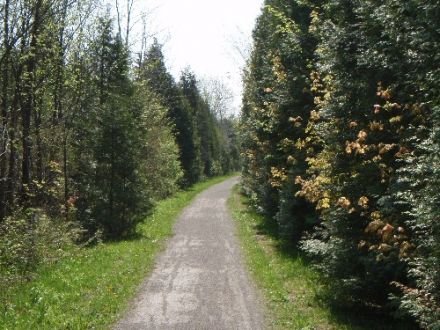
A Journey in 5 Parts: A guide to habitat and selected species By Alan McKeown and Peggy McArthur, June 2002 The Lynn Valley Trail is an abandoned railway line running from Simcoe to Port Dover.
A Journey in 5 Parts: A guide to habitat and selected species
By Alan McKeown and Peggy McArthur, June 2002
The Lynn Valley Trail is an abandoned railway line running from Simcoe to Port Dover. It passes through a number of different environments/habitats found in Norfolk and Haldimand Counties. For the serious or casual naturalist, photographer or the casual observer it provides a multitude of viewing opportunities depending upon the habitat and season. Birds, for example cardinals, catbirds, doves, ducks, eastern bluebirds, goldfinches, red-tail hawks, may be seen or heard. Wildlife, including chipmunks, deer, rabbits, raccoons and squirrels may be observed. Turtles, a variety of frogs, toads and sometimes a snake may be present particularly in the wet areas. In addition, fireflies may provide a spectacular display after dark. The plant life along the trail is diverse depending upon season and location. Species vary from wetland to forest to prairie. Since the trail follows an abandoned railway line, species may vary drastically over a short distance along or across the trail right of way. Trees along the right of way are small, however, the trail passes through woodlots with mature trees. A variety of dogwoods, including thickets of Gray Dogwood, Red Osier Dogwood, and Staghorn Sumac are found along the trail from almost beginning to end. Each section has a variety of berry-bearing shrubs and vines.
This booklet is intended to act as a guide to the habitats and species and is by no means complete nor an inventory. Since many people use the trail or describe locations by road references, this guide will use this means of identifying species along the trail. The reader is challenged to develop their own list in conjunction with a field guide(s) and is encouraged to contact a member of the Lynn Valley Trail Association about any special items spotted along the trail.
A word of caution! Poison Ivy is found in a number of locations off the trail. Be sure you know what it looks like!
The main field guides used for this survey include: A Field Guide to Wildflowers of North-eastern/North-central America, Forest Plants of Central Ontario, Weeds of Ontario, Newcombes Wildflower Guide, The Audubon Society Field Guide to North American Wild Flowers: Eastern Region, A Field Guide to Trees and Shrubs.
NOTE: Guides varied widely in common names, particularly plants such as asters. We have included some examples in the list. This is why the use of scientific names, genus and species, are included. In some cases it is difficult to key out some genera using field guides (e.g., Hawthorns); therefore, we have included the genus and not the species.
Section A: Memorial Drive, Simcoe to DeCou Road
This end of the trail officially starts just after the bridge at Memorial Park Ball Diamond, just past some Mulberry bushes. This section borders on the Brook Conservation Area on the southern edge and trails run off into the Conservation Area. At this point you may choose to visit the Conservation area or branch off onto the Simcoe Walkway. Habitats along the trail in this section include mixed woods, wetlands with drier sites towards DeCou Road. A spring crosses the trail towards DeCou Road. Multiflora Roses line the path and provide a spectacular show of flowers in the spring and rose-hips in the fall. There are many wetland flora evident.
Section B: DeCou Road to Ireland Road
The gurgling of water is prominent as you enter this area and the occasional duck or goose may be found here. The DeCou Road end has a swamp area including a Cedar swamp along the Northeast side. The West side of the trail drops off to the river. Skunk cabbage is found along the trail and emerges in late fall/early winter providing some interesting photo opportunities. The wet habitat continues past Burt Bridge, part way to Robinson Bridge. A spring crosses the trail about halfway from DeCou Road. The trail then heads through mixed woods with white ash, shagbark hickory plus many ferns. There are wide varieties of wetland plants in this area. In late summer you may find a spectacular display of asters – including (in 1996) a rare rose coloured New England Aster, as well as Lobelias, White Snakeroot, and the almost phosphorescent Grass of Parnassus. After Robinson bridge the habitat becomes more open and is lined part way by Sumac and thickets of Gray dogwood. There is a wetland to the north which borders the trail about 200 m east of Robinson bridge. Tussocks of a sedge, Carex stricta, are prominent in this wetland area. Past this area, fields border the Northeast towards Ireland Road with houses to the West. Little Bluestem, a tallgrass prairie grass, may be found towards Ireland Road.
Section C: Ireland Road to Lynn Valley Road
This is a short section, recently disturbed (1995) by road reconstruction, where the trail follows Lynn Valley Road, past farms on one side and the river on the other. As the area has been recently disturbed, there is a wide variety of “weeds” as well as some garden escapes in addition to wild flowers.
Section D: Lynn Valley Road to the Blue Line
This is a drier habitat at the Lynn Valley end. Near the Lynn Valley road, there is a clump of Sassafras. Several hundred meters towards the Blue Line is a section of Indian Grass on the north side and a woodlot to the south. The rich colours of various grasses are prominent in some sections in late August, and particularly the Indian grass, another tallgrass prairie grass, with its feathery seed head that provides quite a photogenic opportunity. Sand Dropseed and Indian Grass are common in late summer and there are a wide variety of asters and goldenrod present. The trail passes through some agricultural land with pasture to the south prior to a woodlot. Toward the Lynn River crossing there is an area where eastern bluebirds frequent.
Section E: Blue Line/Regional Road 3 to Queen Street, Port Dover
This section starts at the Blue Line and goes diagonally to Regional Road 3 and then to Port Dover. At the upper end, there is about 100 meters of a very dry environment. Along the trail there is evidence of prairie remnants, e.g., Indian grass, little bluestem, showy tick trefoil, and at Regional Road 3, a prairie remnant exists. Common Milkweed, Butterfly Weed, Black-eyed Susan, and Wild Bergamot can be found among the grasses. A wetter area follows toward some mixed woods. Turtles can be seen some mornings in late spring along this stretch. About 200 meters along the trail, there is a clump of Big bluestem, a tallgrass prairie grass about 2 metres in height at maturity. A prairie remnant of Little Bluestem and Black-eyed Susan exists halfway towards Port Dover. Along the river there is a meadow with Phlox in spring and Cowparsnips of outstanding size. In the pond in June, Yellow Iris make a spectacular display. In mid-summer, Virgin’s Bower forms a curtain overhanging much of the lower trail and Sand Dropseed is prevalent. Asters are widespread in late summer in the meadow.
| Common Name | Scientific Name | Section |
|---|---|---|
| Alder, European | Alnus glutinosa | A, B, D, E |
| Alder-leafed Buckthorn | Rhamnus alnifolia | E |
| Alfalfa | Medicago sativa | A, B, D, E |
| Alpine Marsh Violet | Viola palustris | B |
| Alsike Clover | Trifolium hybridum | A, B, C, D, E |
| American/Climbing Bittersweet | Celastrus scandens | A, D |
| American/Fly Honeysuckle | Lonicera canadensis | A, B, D, E |
| Asparagus | Asparagus officinalis | A, B, C, D, E |
| Aster – Azure | Aster oolentangiensis (Aster azureus) | D |
| Aster – Bushy | Aster dumosus | A, D, E |
| Aster – Crooked | Aster prenanthoides | A, B, D |
| Aster – Heath | Aster ericoides | B, D, E |
| Aster – Panicled/Eastern Lined | Aster lanceolatus | A, B, D, E |
| Aster – Small White | Aster vimineus | A, B, D, E |
| Aster – Stiff | Aster linariifolius | E |
| Aster – Swamp/Purple Stemmed | Aster puniceus | A, B, D, E |
| Aster – Heart-leaved | Aster cordifolius | A, B, D, E |
| Aster – Long-leaved Blue | Aster longefloris | A, B, D, E |
| Aster – Arrow-leaved | Aster urophyllus/sagittifolius | D |

A volunteer-driven, non-profit organization dedicated to preserving, protecting, and enhancing the Lynn Valley Trail for everyone to enjoy.